
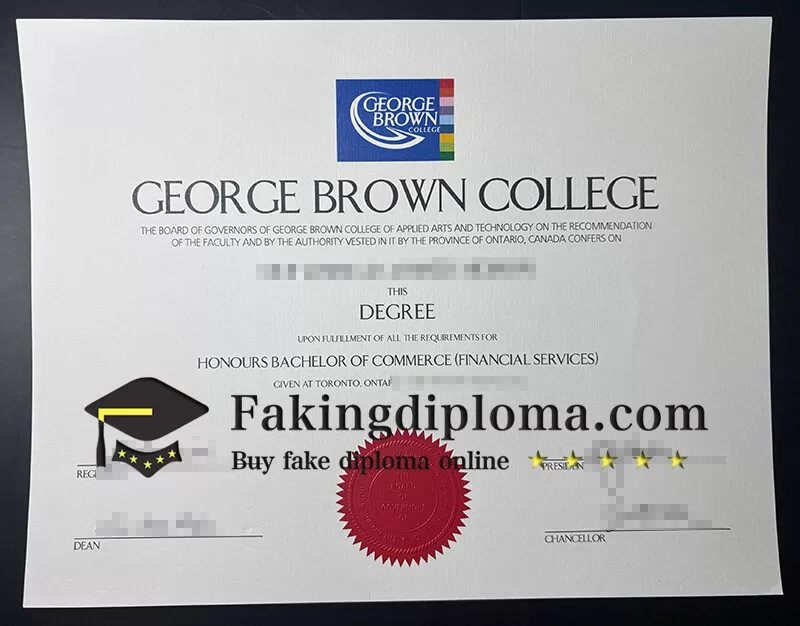
Buy a George Brown College diploma online
Buy a George Brown College diploma.
Order a George Brown College certificate. The college was established during the formation of Ontario’s community college system in 1967. Colleges of Applied Arts and Technology were established on May 21, 1965. The college is named after George Brown, who was an important 19th-century politician and newspaper publisher (he founded the Toronto Globe, forerunner to The Globe and Mail) and was one of the Fathers of Confederation. Where to order a George Brown College fake degree?
The college’s predecessor, the Provincial Institute of Trades (PIT), was founded in 1951 to offer apprentice training on behalf of the provincial Department of Labour. In 1952, the PIT began operation at 21 Nassau Street in Toronto’s Kensington Market and, after expanding with the construction of two additional buildings on the site, was offering programs in lathing and structural steel, barbering, diesel mechanics, jewellery arts, watchmaking, and welding by 1961. In 1962, the province opened the Provincial Institute of Trades and Occupations (PITO), a sister training institute, at 555 Davenport Road near Casa Loma.
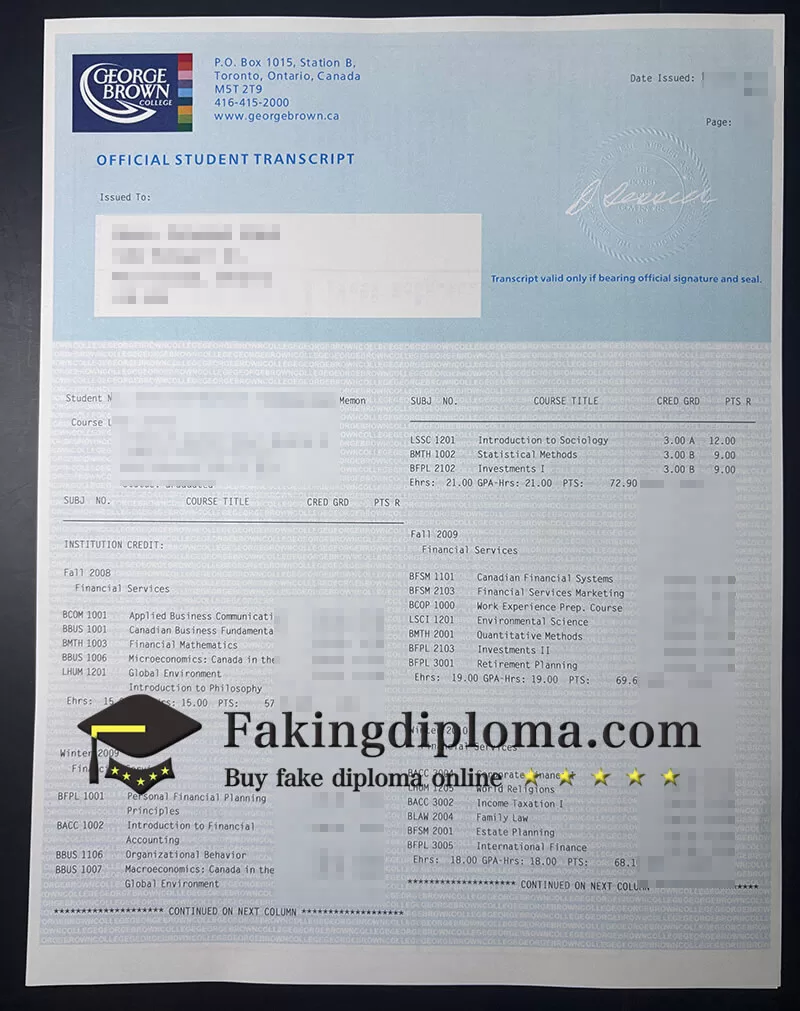
Get George Brown College transcript
Get a George Brown College Degree
Fields of study: Business, Technology, Design, Fine Arts, Health Sciences, Engineering Technology, Hospitality, and more
Degree types:
Honours Bachelor’s degrees
Bachelor’s degrees in collaboration with partner universities
Specializations and concentration options within programs
Typical duration: 4 years for most honours bachelor’s degrees (may vary by program)
Delivery format
Full-time and part-time options (depending on the program)
Co-op/internship components: Many programs include mandatory or optional co-op terms, providing paid work placements related to the field
Work-integrated learning: Emphasizes real-world experience, industry projects, and capstone projects
Notable features
Strong industry partnerships: Collaborations with local and national employers to enhance employability
Practical orientation: Emphasis on hands-on labs, simulations, and applied projects
Pathways:
Articulation agreements with universities for transfer credits
Pathways from diploma programs to degree programs (credit transfer)
Global opportunities: Some programs offer international experiences or partnerships
Facilities and student life
Campuses: Several campuses across Toronto, each with specialized facilities (labs, studios, libraries, career centers)
Career services: Resume reviews, interview coaching, job fairs, and networking opportunities
Student supports: Academic advising, tutoring, accessibility services, and student wellness resources
Admissions and requirements
Typical requirements:
Completion of a recognized secondary education for bachelor’s programs
Proof of English proficiency for non-native speakers (e.g., IELTS, TOEFL) if required
Some programs may require a portfolio, auditions, or additional prerequisites
Application: Degree programs are typically competitive; meeting minimum requirements doesn’t guarantee admission due to capacity constraints


