
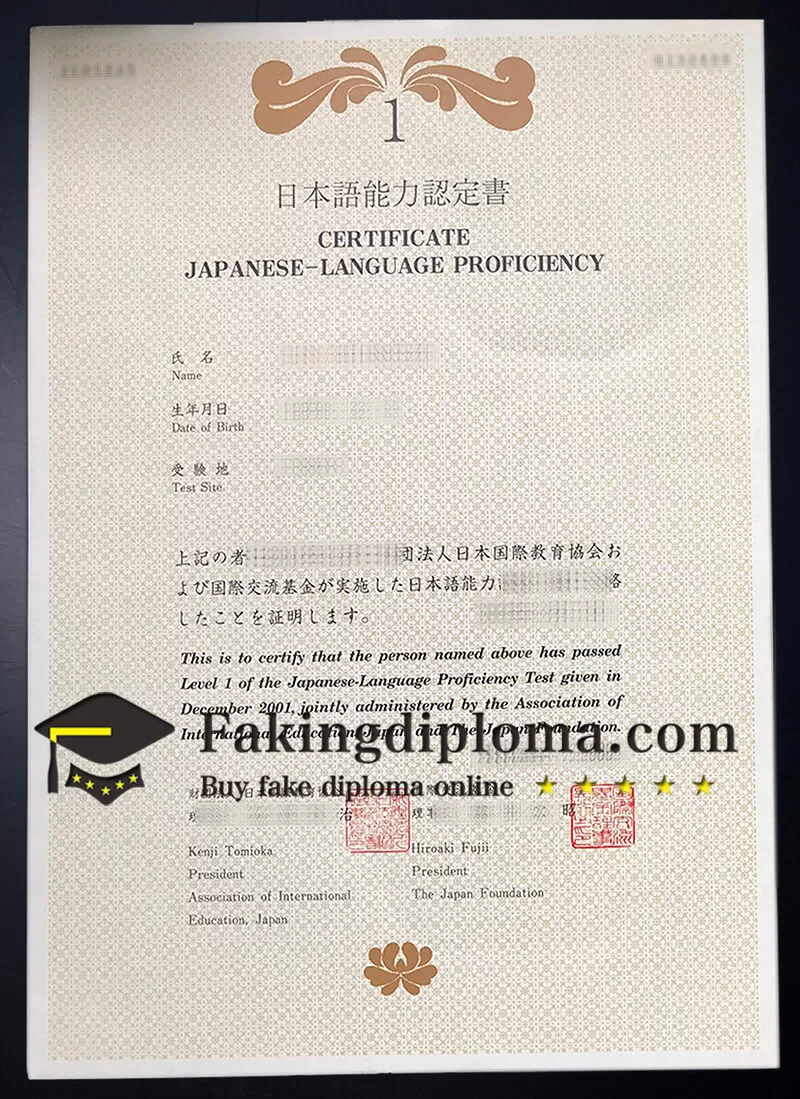
make Japanese Language Proficiency certificate online
How to buy Japanese Language Proficiency certificate?
make JLPT fake certificate, get JLPT certificate online. The Japanese-Language Proficiency Test (日本語能力試験, Nihongo Nōryoku Shiken), or JLPT, is a standardized criterion-referenced test to evaluate and certify Japanese language proficiency for non-native speakers, covering language knowledge, reading ability, and listening ability. The test is held twice a year in Japan and selected countries (on the first Sunday of July and December), and once a year in other regions (either on the first Sunday of December or July depending on region). The JLPT is conducted by the Japan Foundation for tests overseas (with cooperation of local host institutions), and Japan Educational Exchanges and Services for tests in Japan.
The JLPT consists of five independent levels of certification, with 5 the lowest and 1 the highest. Until 2009, the test had four levels of certification. JLPT certificates do not expire or become invalid over time. get fake JLPT certificate in Japan
Great—let’s dive into Japanese Language Proficiency. Could you clarify what you’re aiming for? Here are a few common directions:
Can I order JLPT fake certificate?
- JLPT (Japanese Language Proficiency Test) prep
- Levels: N5 (basic) up to N1 (advanced)
- Study plan, vocabulary lists, grammar points, reading/listening practice
- Business Japanese
- Keigo (敬語), emails, meeting phrases
- Conversational Japanese
- Everyday phrase patterns, pronunciation tips
- Kanji learning
- Strategy to learn kanji efficiently, radical groups, frequency lists
- Self-assessment
- Quick diagnostic to gauge current level and gaps
- Resources
- Apps, textbooks, online courses, practice tests
Quick starter plan (if you’re aiming for JLPT N5-N4, beginner)
- Vocabulary foundation: ~1,000 common words for N4; 300-500 for N5
- Grammar basics: particles (は, が, を, に, で), verb conjugations (masu-form, nai-form), past tense
- Kana mastery: Hiragana and Katakana fluency
- Kanji exposure: 100-200 basic kanji with meanings
- Practice: 2–3 short listening/reading passages per week
- Mock tests: monthly to track progress
What I can offer right away
- A personalized study plan with a timeline tailored to your target level
- A curated starter vocabulary list with frequency-based words
- A grammar cheat sheet for your target level
- Sample practice questions (reading/listening) with explanations
- Study tips for memory, retention, and exam strategy


